The history of India can never be told without referring to the greatest king who ever ruled on our lands. King Ashoka, or Samraat Ashoka ruled most of the Indian subcontinent from 269 BC to 232 BC. He was the only king in our history to have ruled over a vast majority of land.
Ashoka (or "Ashok", I would omit this extra 'a' as it is not an English word) was the grandson of Chandragupta Maurya, the founder of Maurya dynasty. I have written much about Chandragupta Maurya in my earlier post, Chandragupta Maurya: The first emperor of United India.
Chandragupta Maurya's son was Bindusar and Bindusar had number of queens. One of his queens was Shubadrangi (also known as Dhamma). It is believed that Shubadrangi was from a poor family and her reputation as compared to other queens was very low and she was unpopular. So much so, Bindusar himself never gave much importance to Shubhadrangi. Ashok was born to Shubadrangi in 304 BC. He was among the many sons Bindusar had. When he was born, his mother said that now I am 'shoka-mukta' (devoid of all sorrow) hence the child was named as 'Ashok'. Ashok displayed extra ordinary skills in fighting and military tactics at an early age. A legend also says that he killed a lion without any weapon in his teens. Being the son of a king he was given royal training, and he soon proved to be all worthy of succeeding the king.
Some legends say that Bindusar had a century of sons. He favored his one particular son whom many stories name Sushim. Bindusar wanted Sushim to succeed him as a king after his death. The ministers however wanted Ashok. Thanks to his military tactics and his persona he displayed at a younger age, Ashok was able to impress many nobles and ministers of his father.
When Bindusar learnt about his sons valor and the intentions of his minsters that they wanted Ashok to rule the kingdom after his death, he got scared of the might of his own son and sent him to curb revolt in other kingdoms. It started with Ujjain (the then existing Avanti kingdom, in modern Madhya Pradesh). After Ashok curbed a revolt in Ujjain, he was appointed as a governer for Avanti. Later when his brothers fail to curb another great revolt in Takshashila (in modern Pakistan) Ashoka was sent there.
Meanwhile Bindusar's time had come. On his death bed, he wanted Sushim to be crowned as king. On learning this, the ministers called for Ashok to come to Magadha at once. It is said that Ashok entered the capital riding the royal elephant and he was crowned as the new king. Many sources confirm that Ashok went on a killing rampage and annihilated all his brothers. Some sources say that he spared the youngest one named Tissa, who later joined Buddhism.
Ashok was an ambitious king who believed in the power of might. He led many military expeditions in the kingdoms across Indian continent and challenged, fought and killed countless people. It is believed that he had a secret torture chamber called 'Ashok's Hell' where his executioner used to perform unspeakable torture acts to the captives. For all these acts of his, he was named as 'Chanda' Ashok (barbaric Ashok)
Ashok won many kingdoms in east, west, north, south. His empire established through the power of sword stretched from Western Iran in the West to Bangladesh, Bhutan in East, Kashmir, South-east Turkmenistan, South Uzbekistan, Tajikistan in the North and as far as Tamil-Nadu in the South. He actually ruled almost the entire stretch of present Indian sub-continent.
The only kingdom which still wasn't included in his territories was Kaling (modern Orissa). Kalinga was ruled by independent local leaders. Ashok waged a war against the Kaling. The Kalingas retaliated with force and Ashok's general was killed. Furious at this, Ashok ordered full strength assault on Kaling. Kaling was decimated by Ashok's forces. With the victory over Kaling, Ashok expanded his kingdom and included the territories which even his grand father could not win.
However, when he saw the amount of bloodshed that took place in the war (its is said that around 10000 people died in the war), he felt ashamed. He understood the futility of war and bloodshed. He left the path of violence started following Buddhism. He was very affected by the teachings of Buddha. He decided to undo all his evil deeds. He burnt his chamber of torture and started working for betterment of his subjects and vast empire.
His administrative system was anyway flawless following the footsteps of his mighty grandfather. His administrator structure followed division of the vast land that he ruled in smaller administrative bodies much like the present hierarchical structure. Though autonomy in lifestyle was allowed in different provinces, no province was allowed to go as far as a revolt. However, Ashok took steps to reduce the harshness of the punishment. The teachings of Buddha transformed him from 'Chanda' Ashok to sympathetic Ashok, who promoted the equality of men. He also appointed special ministers to take care matters of people following different lifestyles and belief systems.
Ashok also undertook the massive project of constructing structures to depict his lifestyle and teachings of Buddhism and the main pillars of his administrative style, called 'edicts'. Ashok constructed tall 20-30 feet high stone structures called 'edicts' across his empire. Most of those edicts have been demolished in the course of time. The image of Lion symbolises the Mauryan empire. One of the Ashok's edicts showed the four lions standing back to back with a circle of 24 spokes. These symbols have been recognised as national symbol of India. The 24 spoke wheel finds its place in Indian national flag.
Ashok also did great work for which he finds special place in Indian history and perhaps world's history. He send emissaries across his kingdom and outside his kingdom to spread Buddhism. He is responsible for promotion and establishment of Buddhism in China and Sri Lanka and other neighbouring countries.
Many legends are also associated with Ashok. The story of his life is depicted in 'Ashokavadana' a 2nd century text of Buddhism. Some believe that Ashok was an ardent follower of Buddha from the beginning. Some believe that he erected those edicts throughout his empire with inscriptions describing all the good things of his reign only to wash off the guilt of all the wrong things he had done.
There is yet another legend associated with Ashok about the secret society of nine unknown men whom he entrusted with knowledge of power that different areas of sciences, technology possess which could endanger or threaten the existence of life and harmony on the earth. Ashok believed that the power of certain knowledge should be protected as if they fell in wrong hands, could led to disaster.
These areas are:
-M
Ashoka (or "Ashok", I would omit this extra 'a' as it is not an English word) was the grandson of Chandragupta Maurya, the founder of Maurya dynasty. I have written much about Chandragupta Maurya in my earlier post, Chandragupta Maurya: The first emperor of United India.
Chandragupta Maurya's son was Bindusar and Bindusar had number of queens. One of his queens was Shubadrangi (also known as Dhamma). It is believed that Shubadrangi was from a poor family and her reputation as compared to other queens was very low and she was unpopular. So much so, Bindusar himself never gave much importance to Shubhadrangi. Ashok was born to Shubadrangi in 304 BC. He was among the many sons Bindusar had. When he was born, his mother said that now I am 'shoka-mukta' (devoid of all sorrow) hence the child was named as 'Ashok'. Ashok displayed extra ordinary skills in fighting and military tactics at an early age. A legend also says that he killed a lion without any weapon in his teens. Being the son of a king he was given royal training, and he soon proved to be all worthy of succeeding the king.
Some legends say that Bindusar had a century of sons. He favored his one particular son whom many stories name Sushim. Bindusar wanted Sushim to succeed him as a king after his death. The ministers however wanted Ashok. Thanks to his military tactics and his persona he displayed at a younger age, Ashok was able to impress many nobles and ministers of his father.
When Bindusar learnt about his sons valor and the intentions of his minsters that they wanted Ashok to rule the kingdom after his death, he got scared of the might of his own son and sent him to curb revolt in other kingdoms. It started with Ujjain (the then existing Avanti kingdom, in modern Madhya Pradesh). After Ashok curbed a revolt in Ujjain, he was appointed as a governer for Avanti. Later when his brothers fail to curb another great revolt in Takshashila (in modern Pakistan) Ashoka was sent there.
Meanwhile Bindusar's time had come. On his death bed, he wanted Sushim to be crowned as king. On learning this, the ministers called for Ashok to come to Magadha at once. It is said that Ashok entered the capital riding the royal elephant and he was crowned as the new king. Many sources confirm that Ashok went on a killing rampage and annihilated all his brothers. Some sources say that he spared the youngest one named Tissa, who later joined Buddhism.
Ashok was an ambitious king who believed in the power of might. He led many military expeditions in the kingdoms across Indian continent and challenged, fought and killed countless people. It is believed that he had a secret torture chamber called 'Ashok's Hell' where his executioner used to perform unspeakable torture acts to the captives. For all these acts of his, he was named as 'Chanda' Ashok (barbaric Ashok)
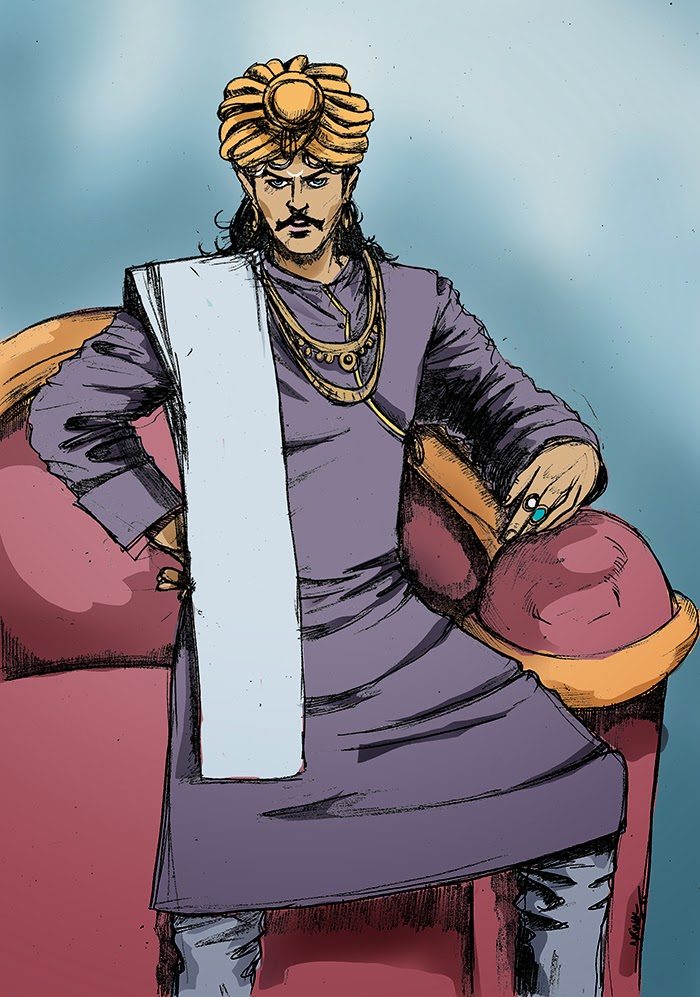 |
| King Ashoka-drawn by Mrinal Rai |
 |
| Ashoka's empire stretch |
 |
| Kalinga war transformed Ashoka-drawn by Mrinal Rai |
Ashok also undertook the massive project of constructing structures to depict his lifestyle and teachings of Buddhism and the main pillars of his administrative style, called 'edicts'. Ashok constructed tall 20-30 feet high stone structures called 'edicts' across his empire. Most of those edicts have been demolished in the course of time. The image of Lion symbolises the Mauryan empire. One of the Ashok's edicts showed the four lions standing back to back with a circle of 24 spokes. These symbols have been recognised as national symbol of India. The 24 spoke wheel finds its place in Indian national flag.
 |
| King Ashoka and his edicts-drawn by Mrinal Rai |
Many legends are also associated with Ashok. The story of his life is depicted in 'Ashokavadana' a 2nd century text of Buddhism. Some believe that Ashok was an ardent follower of Buddha from the beginning. Some believe that he erected those edicts throughout his empire with inscriptions describing all the good things of his reign only to wash off the guilt of all the wrong things he had done.
There is yet another legend associated with Ashok about the secret society of nine unknown men whom he entrusted with knowledge of power that different areas of sciences, technology possess which could endanger or threaten the existence of life and harmony on the earth. Ashok believed that the power of certain knowledge should be protected as if they fell in wrong hands, could led to disaster.
These areas are:
- Propaganda and Psychological warfare, which can entice people to go for war by getting instigated because of a planned propoganda and brainwashing Psychology.
- Physiology power, knowing the touch of death. It is believed that art of Judo originated from here.
- Microbiology. It is believed that chemical weapons developed using this knowledge.
- Transmutation of Gold and other metals through knowledge of Alchemy
- Communication with extra terrestrials; researched but still unexplored
- Gravity and Anti-Gravity (Vimana) sciene; the Airforce and Airplanes are examples.
- Cosmology; the science of space travel; still unexplored through humans
- Light and technology to modify the speed of light; still unexplored
- Sociology; including laws of predicting rise and fall of empire.: Well, this is debatable.
 |
| Ashoka and secret society of Nine unknown men - drawn by Mrinal Rai |
This legend is the subject of the novel "The Nine Unkown" by Talbot Mundy published in 1923.
It is believed that none of the sons of Ashok proved to be worthy successor. His son Kunal was blinded by one of his jealous wives. Kunal's son was worthy to be a king as seen by Ashok, but he was too young at that time. Another of Ashok's grandson Dashratha succeeded him.
Ashoka died at a very old age peacefully in around 232 BC. After his death, Dasharatha was not able to control the declaration of autonomy by various kingdoms and imperial rule of Mauryan Kingdom started on its downward curve.
Ashok as a king and as a person will always remain as a great example for those who want to be in any administrative position or who want to give up their vices. He was indeed the greatest king of India and perhaps one of the greatest kings of the world. I salute him.
-M


